
Executive Summary
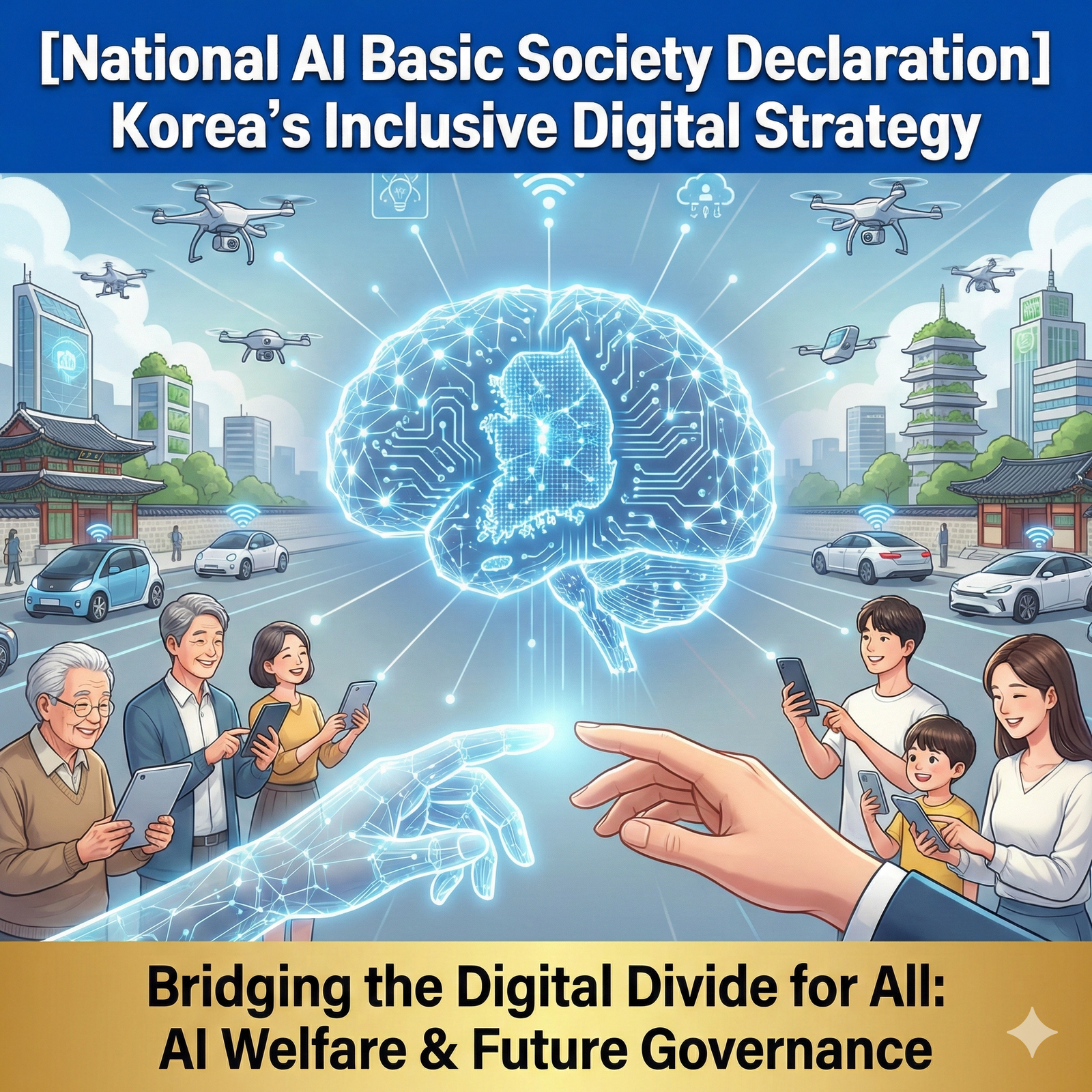
The South Korean government is pushing the construction of a ‘National AI Basic Society’ as a core national agenda to ensure the benefits of technological advancements are shared by all citizens, not biased towards specific groups. This goes beyond industrial promotion, aiming to solve social issues like aging, low birth rates, and polarization while innovating the quality of public services using Artificial Intelligence. It is an attempt to recognize AI accessibility as a ‘fundamental right’ at the national level and establish new social safety nets and ethical norms aimed for the era of digital deepening.
Detailed Guide: Strategies and Sector-Specific Action Plans for the National AI Basic Society
The ‘National AI Basic Society’ declared by the Korean government means that technology takes root across society as a tool to assist and expand human life. The following are the key strategies and specific action plans by sector to realize this.
| Category | Key Strategy | Detailed Action Plans and Expected Effects |
| AI Literacy & Education | Strengthening AI utilization capabilities across the life cycle | Substantializing Public Education (K-12): Expanding information subject hours, making SW/AI education mandatory, and introducing AI digital textbooks. Lifelong Education for All: Expanding ‘Digital Learning Centers’ for adults and incumbents, establishing an AI utilization ability evaluation system. Tailored Education for Vulnerable Groups: Providing outreach digital/AI education services for the elderly, disabled, and multicultural families to bridge the information gap. |
| Public & Admin Innovation | Realizing an AI-based Intelligent Government | Introducing AI Administrative Assistants: Automating simple repetitive tasks for civil servants to increase administrative efficiency and focus on public services. Intelligent Civil Services: Building hyper-scale AI-based chatbots and call centers capable of 24/7 response to drastically shorten civil complaint processing speed. Data-Driven Policy Making: Establishing welfare policies without blind spots and disaster safety measures through AI analysis of various social data. |
| Welfare & Social Safety Net | Strengthening care and safety using AI technology | Spreading AI Care Robots/Services: Supplying AI services for checking in on seniors living alone and single-person households, detecting emergencies, and providing emotional support. Advancing Assistive Technology for Disabled: Supporting the development of AI-based voice-to-subtitle conversion and object recognition services for the visually and hearing impaired. Crime and Disaster Prediction: Utilizing intelligent CCTV and prediction systems to monitor crime-vulnerable areas and establish early warning systems for natural disasters. |
| Daily Life & Industrial Spread | Universalizing citizen-tangible AI services | Supporting AI Adoption for Small Business Owners: Providing vouchers and consulting for introducing AI solutions in marketing, customer management, and store operations. Spreading Region-Specific AI: Supporting the integration of AI technology into specialized industries (e.g., Smart Farm, Smart Factory) by regional hubs. Lifestyle-Integrated Services: Expanding personalized convenient services using AI across daily life, including transportation, medical care, and finance. |
| Ethics & Infrastructure | Creating a trustworthy AI ecosystem | Establishing AI Ethical Standards: Concretizing AI development and utilization guidelines and refining legal systems based on the ‘National AI Ethical Standards’. Strengthening Data Sovereignty & Security: Reinforcing technical/administrative safety measures for personal information protection and revitalizing the MyData business. Advancing High-Speed Infrastructure: Providing a seamless AI service environment by expanding 5G/6G networks and public clouds. |
Action Tips: Guide for Global Residents Adapting to Korea’s AI Society
These are step-by-step action tips for global residents (registered foreigners, etc.) to enhance convenience in life according to Korea’s fast AI transition speed.
- Sign up for Integrated Digital Platforms: Korea’s public services revolve around digital platforms like ‘Government24’ and ‘Hometax’. Use your Alien Registration Number to sign up for essential apps and issue certificates.
- Utilize Multilingual AI Translation Services: If communication is difficult when visiting public institutions or in daily life, actively use advanced AI translation apps like ‘Papago’ or the support of the Immigration Contact Center (1345).
- Check Local Government Digital Education: Check and participate in basic digital education programs, such as smartphone usage and kiosk instructions, offered by each local government or foreigner support center.
- Manage Personal Information Consent: Develop the habit of clearly understanding essential personal information provision consent when using AI services and selectively managing optional agreements like receiving marketing information.
FAQ (Frequently Asked Questions)
- Q1: Is the ‘National AI Basic Society Declaration’ a policy only for technical experts?
- A1: No. The core of this declaration is to ensure that all citizens, regardless of age, income, or region of residence, enjoy the benefits of AI technology like a ‘fundamental right’. The primary goal is to create an inclusive society by strengthening education and support for the digitally marginalized.
- Q2: Are there personal information leakages or ethical issues with the full-scale introduction of AI?
- A2: The Korean government emphasizes ‘Trustworthy AI’ alongside AI proliferation. It is establishing national AI ethical standards, strengthening personal information protection laws, and concurrently preparing legal and institutional mechanisms to prevent the abuse and misuse of AI technology.
- Q3: Are foreigners residing in Korea also subject to these AI-based public services?
- A3: Yes. Residents who legally stay and have completed foreigner registration are included in most administrative and public services. Foreigners’ administrative access is expected to further improve as AI-based multilingual support civil services expand.
Sources
- Ministry of Science and ICT (MSIT) Press Releases and Policy Announcements
- Presidential Committee on the Digital Platform Government Strategy Reports
- Joint Ministry Plan for ‘National AI Daily Life Implementation’