
Key Summary
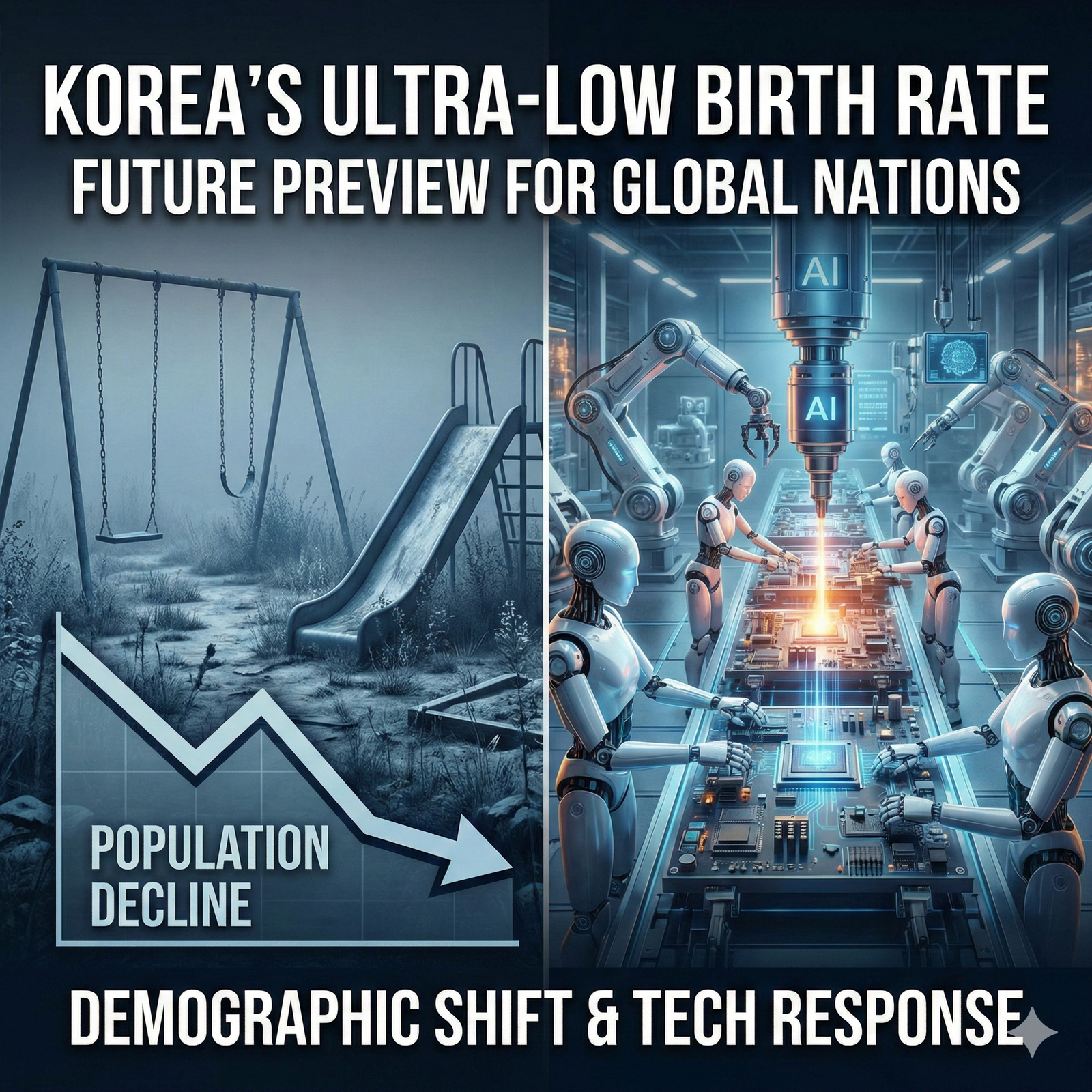
- South Korea is undergoing a dramatic demographic shift with the world’s lowest total fertility rate, serving as a social testbed for challenges that other developed nations will soon face.
- The primary causes—competitive pressure in high-density societies, rising housing costs, and evolving social values—are core issues that major global cities and aging societies must address collectively.
- South Korea’s proactive policy responses and the outcomes of its social experiments will serve as crucial milestones for establishing global standards to maintain economic growth and social cohesion in an era of population decline.
Detailed Guide: Analyzing South Korea’s Demographic Change and Global Implications
South Korea’s low birth rate is a complex interplay of various social factors. We have summarized the key indicators so global readers can project their own futures through the Korean lens.
1. Key Indicators and Social Background of South Korea’s Low Birth Rate
| Category | Current Status (As of 2025-2026) | Implications for Developed Nations |
| Total Fertility Rate | World’s lowest (Remaining below 0.7) | Need to prepare for social shocks when the replacement level (2.1) collapses |
| Density & Competition | Concentration in Seoul & intense education rivalry | Evidence of how urban overcrowding negatively impacts procreation sentiment |
| Economic Burden | High housing costs & private education spending | Suggests policy ineffectiveness without addressing wealth inequality |
| Value Shift | Rise of single-person households & delayed marriage | Rapid transition from family-centric to individual quality-of-life-centric society |
2. Structural Changes and Response Strategies
- Labor Market Restructuring: Accelerating the adoption of AI and robotics, and developing strategies to utilize the elderly workforce to counter the decline in the working-age population.
- Sustainability of Social Security: Reforming pension and healthcare systems is a common task for all aging societies, making Korea’s reform process a significant reference case.
- Immigration Policy Paradigm Shift: The social consensus on active immigrant influx and integration costs will become a key issue for all advanced nations.
Action Tips: Step-by-Step Plan for Surviving the Era of Demographic Change
- Enhance Technological Adaptability: Improve proficiency in automation and AI tools. This is key to maintaining productivity amidst labor shortages.
- Diversify Asset Portfolios: Population decline affects real estate and domestic markets. Manage risk by diversifying localized assets into global portfolios.
- Adopt Flexible Views on Family: Move beyond traditional family models and remain open to diverse cohabitation forms to prevent isolation and secure a social safety net.
FAQ
- Q1: How is Korea’s low birth rate different from other countries?
- A1: The speed of change is unprecedented. Korea is experiencing in 10-20 years what took others decades, testing the adaptation speed of social systems.
- Q2: Can government policies solve this?
- A2: Short-term cash incentives are insufficient. Structural solutions like housing stability and work-life balance must be integrated for long-term efficacy.
- Q3: Why are global investors concerned about Korea’s demographics?
- A3: It may lower potential growth due to shrinking domestic markets. However, Korea’s advanced AI/robotics adoption is also seen as a new investment opportunity.
Source
- Statistics Korea (KOSTAT) 2025 Demographic Reports
- OECD Analysis of Total Fertility Rates by Country
- Korea Development Institute (KDI) Economic Growth Outlook on Demographic Shifts