
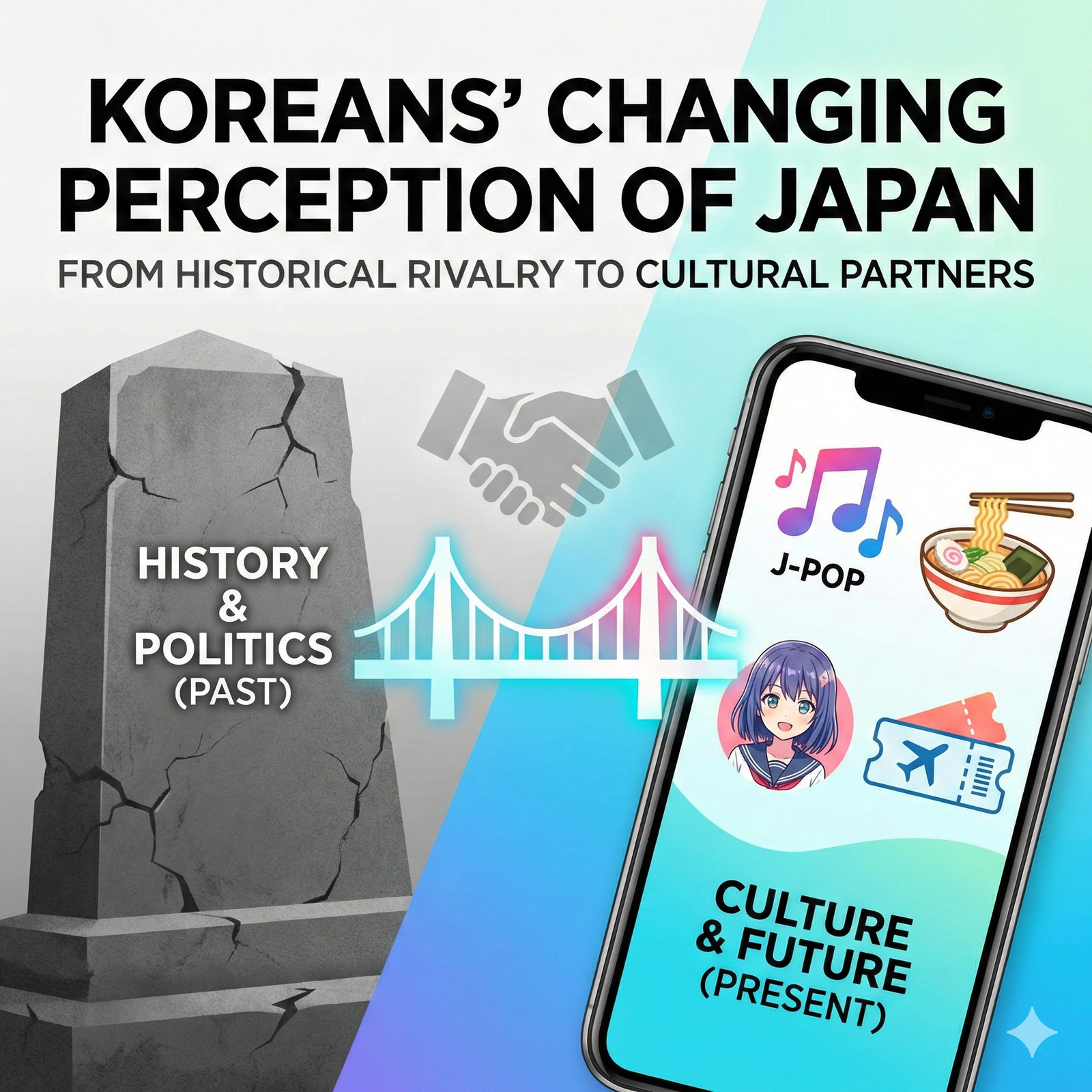
[Global Report] The Great Shift: From Historical Rivalry to Cultural Partners—Koreans’ Changing Perception of Japan in 2026
Key Summary
- As of 2026, South Koreans’ favorability toward Japan has reached an all-time high, with surveys indicating that 56% to over 63% of respondents hold a positive impression of the neighboring nation.
- A distinct phenomenon of “Perceptual Decoupling” has emerged, where Koreans separate historical and political tensions from social and cultural consumption. This shift is led by the MZ generation, who view Japan as a pragmatic partner and an attractive destination for lifestyle and culture.
- Regarding foreign policy, a growing majority now prioritizes “future-oriented cooperation in economy and security” over the “resolution of pending historical issues,” signaling a qualitative transformation in bilateral relations.
Detailed Guide: Analysis of the Shifting Sentiment and Key Drivers
The sentiment of South Koreans toward Japan has evolved from unilateral hostility into a complex and pragmatic form. The following tables analyze these changes based on recent public opinion data.
1. Transition of Korean Perception (2019 “No Japan” vs. 2025-2026 Present)
| Category | 2019 (Boycott Era) | 2025-2026 (Present) | Key Takeaway |
| Favorability Rating | Approx. 31.7% (Near historic lows) | 56.4% ~ 63.3% (Record Highs) | A “Golden Cross” where positive views surpass negatives |
| Cognitive Structure | Unified politics/history with culture (Boycott) | Decoupling: History/Politics vs. Society/Culture | Flexibility to consume culture despite political friction |
| Policy Priority | Historical justice as a prerequisite | Future-oriented coop. (Econ/Security) (49.6%) | Spread of pragmatic diplomacy centered on national interest |
| Tourism to Japan | Social stigma and self-restraint | No. 1 Preferred Foreign Destination | Firsthand experiences accelerating the break of stereotypes |
2. Generational Characteristics (Impact of the MZ Generation)
- High Approval Ratings: Favorability among those aged 18-29 (74%) and in their 30s (74.1%) significantly exceeds the national average, showing a much more open attitude.
- Focus on Fairness: Younger Koreans prioritize “fairness” and “justifiable treatment” over ethnic nationalism. They criticize Japan’s wrongdoings but avoid indiscriminate bashing not grounded in facts.
- Japan as a Consumption Object: They use Japanese products and content (The First Slam Dunk, J-Pop, Anime) as a means of personal expression and “Meaning Out”.
Action Tips: Plan for Understanding the New Korean Sentiment Toward Japan
- Observe Cultural Integration: Visit trendy areas in Seoul like Seongsu-dong or Hongdae. Notice how naturally Japanese City Pop or Japanese fashion brands are integrated into the local lifestyle.
- Monitor Popularity Charts: Check domestic music streaming charts or OTT rankings. The prevalence of Japanese artists or anime series reflects cultural intimacy beyond just a passing fad.
- Mind the Etiquette: Cultural openness does not mean historical issues have disappeared. Respect the cultural affinity while remaining sensitive and cautious when historical topics like the Dokdo islets or forced labor are mentioned.
FAQ
- Q1: Have Koreans completely forgotten about historical issues?
- A1: No. Dissatisfaction with the Japanese government’s historical perception remains a primary source of anti-Japanese sentiment. However, this is no longer linked to a hatred of individual Japanese people or the culture as a whole—this is the “Decoupling” effect.
- Q2: Why is the MZ generation particularly favorable toward Japan?
- A2: They did not experience colonization or the subsequent period of extreme poverty. Growing up in a digital environment, they accessed Japanese culture freely and tend to value individual taste and utility over nationalistic sentiments.
- Q3: Will this positive trend last politically?
- A3: Most Koreans expect the relationship to remain stable or improve over the next year. However, public opinion remains fluid and could react sensitively to provocative remarks or policy shifts from Japanese politicians.
Source
- East Asia Institute (EAI) & Genron NPO ‘2025 Joint Opinion Poll’
- Yonhap News ‘Record High Favorability Toward Japan’ (2026.02)
- Hankook Research ‘2025 Perception Survey on Japan’
- SNU Institute for Peace and Unification Studies ‘Korean Youth’s Perception’