
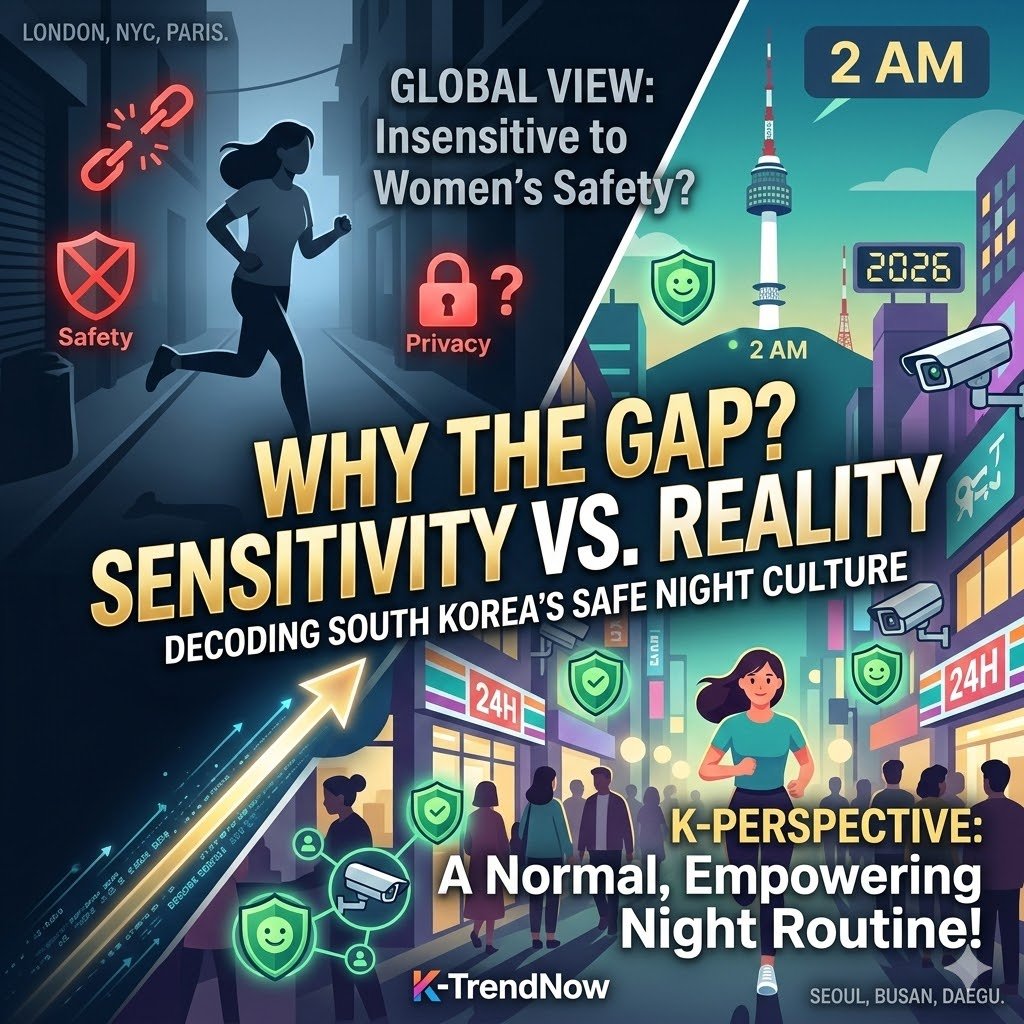
Core Summary & The Golden Nugget
- When Samsung’s Night Owls campaign faced heavy criticism in the West for being “tone-deaf” to women’s safety, the reaction in South Korea was largely one of confusion: “Why is this a problem?”
- For Koreans, 2 AM is not a time of fear, but a productive window for “Self-Management” and the “God-saeng” (living life to the fullest) lifestyle, backed by an unwavering trust in the nation’s ubiquitous safety infrastructure.
- This post explores the unique emotional judgment of Koreans and the urban structure that makes a solo 2 AM run feel like an empowering routine rather than a dangerous risk for global readers to understand the cultural gap.
The One Thing to Remember
In Korea, safety is not a luxury you have to fight for; it is an invisible, 24/7 social infrastructure that functions as a “default setting” for daily life.
The Deep Dive: Decoding the Mental Gap Between K-Reality and Global Sensitivity
While global audiences saw a woman in a vulnerable position, South Koreans saw a person with high willpower. This discrepancy isn’t due to a lack of empathy, but rather a completely different lived experience of the urban environment.
Mental Map Comparison: Navigating the Night
| Feature | Global Perspective (EU/North America) | South Korean Perspective | Cultural Context |
| Perception of 2 AM | A time of isolation and potential threat | A time for “God-saeng” (Productive living) | Difference in social time-definition |
| Environmental Trust | Focus on dark spots and “blind alleys” | Focus on 24h stores and CCTV density | Confidence in visibility |
| The Ad’s Protagonist | A potential victim in a risky fantasy | A disciplined individual in a modern reality | Emphasis on personal agency vs. risk |
| Primary Safety Anchor | Personal vigilance and luck | Institutional and technological guardrails | Level of social trust capital |
3 Reasons Why Koreans Found the Backlash “Puzzling”
- The “God-saeng” Aspiration: In modern Korean society, there is a massive cultural trend called God-saeng, which involves waking up early or staying up late to exercise, study, or work on personal growth. To a Korean viewer, the woman in the ad was a “hero of her own life,” embodying the ultimate discipline that the younger generation admires.
- Infrastructure as a “Social Promise”: South Koreans have grown up in an environment where high-definition CCTV, bright LED streetlights every few meters, and “Safe Return Home” services are the norm. They don’t see the night as a void; they see it as a managed space. The data export of high-definition maps in 2026 has only deepened this sense of being “connected and protected” at all times.
- Empirical Evidence: Seeing is BelievingIn cities like Seoul, it is an everyday reality to see women walking home alone from work or jogging in public parks at 1 or 2 AM. Because Koreans see this with their own eyes daily, they perceived the ad as a documentary-like reflection of their life, making the “unrealistic” labels from overseas feel, ironically, unrealistic to them.
Action Plan: How an International Visitor Can Safely Experience K-Night Life
Step 1: Use 24-Hour Convenience Stores as Safety Hubs. In Korea, convenience stores are official “safe havens.” If you ever feel uneasy, stepping into one of these brightly lit, 24/7 monitored spaces is the quickest way to find help or catch your breath.
Step 2: Trust the “Safe Route” on Google Maps. With the full 2026 navigation update, Google Maps in Korea now highlights routes that are well-lit and frequently traveled by others, ensuring you stay on the most secure path.
Step 3: Join the “Midnight Runners” at Han River. If you want to understand the ad, go to the Han River Park at midnight. You will see hundreds of people of all genders exercising, giving you a firsthand look at the “Collective Safety” that Koreans take for granted.
FAQ: Bridging the Cultural Divide
Q1: Do Koreans not care about violence against women?
This is a misconception. Korea has a very active and loud social discourse regarding gender-based violence. However, this specific ad was judged against the backdrop of urban infrastructure, where Koreans feel their city is uniquely designed to mitigate those risks compared to other global metropolises.
Q2: Is this safety level consistent across all of Korea?
While major cities like Seoul, Busan, and Daegu have the highest density of infrastructure, the general standard of safety and the 24-hour culture are remarkably consistent throughout the country.
Q3: What did global brands learn from this?
The key lesson was that “Universal Values” (like safety) are interpreted through “Local Realities.” A global campaign must acknowledge that a sign of freedom in one culture might be a sign of danger in another, requiring a more nuanced narrative.
Global Engagement Question
In your culture, is safety considered a personal responsibility or a government-guaranteed right? After learning about the Korean perspective, does the Samsung ad feel any different to you? We invite you to share your thoughts on how your environment shapes your perception of “The Night.”