
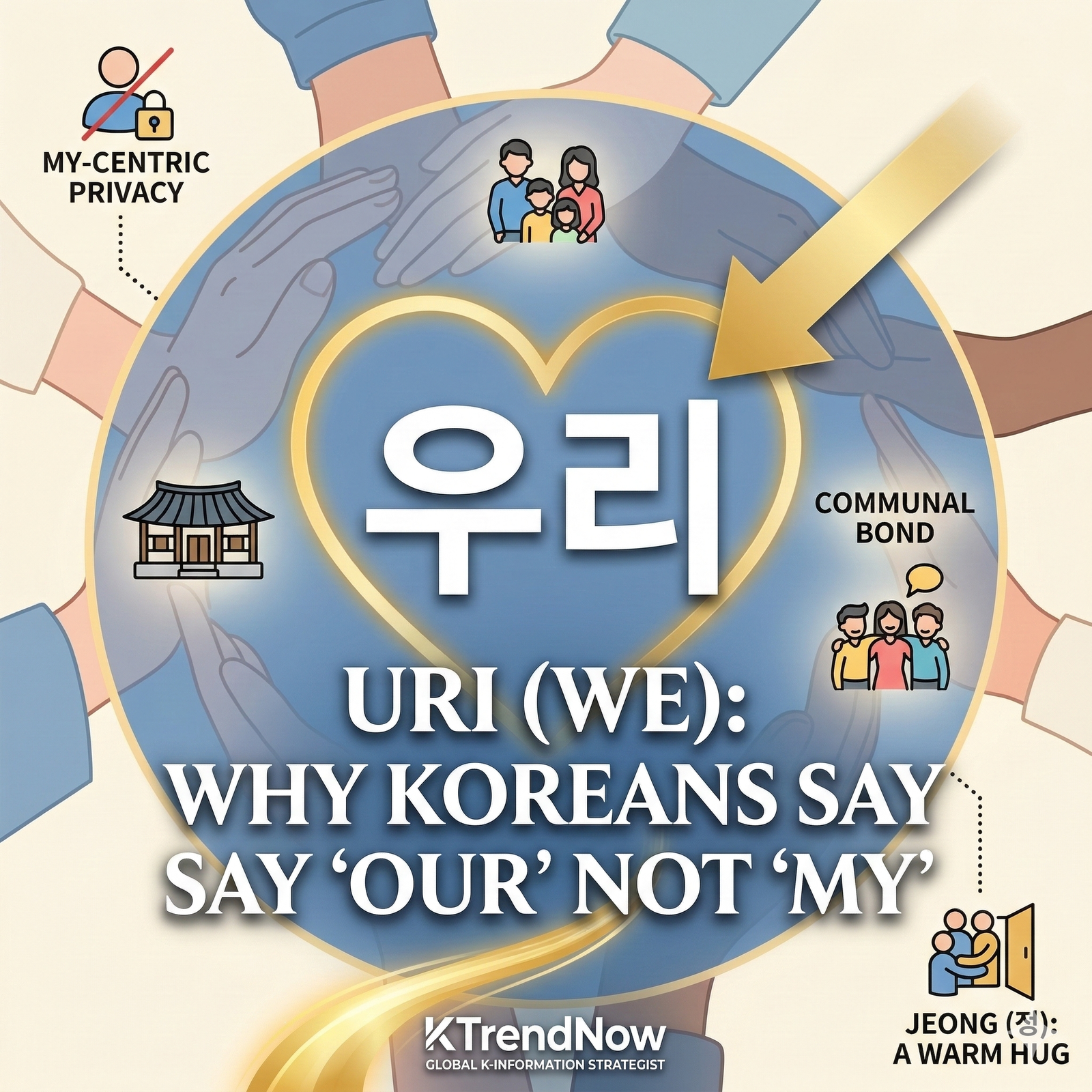
Have you ever been confused when a Korean friend introduced their mother as “Our mother” or referred to their own home as “Our house”? To an English speaker, the word “Our” implies shared ownership or a plural subject. However, in the Korean language, the word “Uri” (우리) is a profound cultural anchor that defines how a person relates to their world.
Understanding the “Uri” concept is the ultimate cheat code for anyone looking to build deep, meaningful relationships in South Korea. In this guide, we will explore the linguistic layers of “Uri” and how this communal DNA continues to shape Korean society even in the high-tech, individualistic era of 2026.
Core Summary & The Golden Nugget
- Koreans habitually use “Our” (Uri) for personal things like family, homes, and even spouses, which reflects a cultural emphasis on collective belonging rather than individual ownership.
- The root of “Uri” lies in Korea’s history of communal farming and Confucian values, manifesting today as “Jeong” (情)—a deep sense of attachment and social bond.
- In a business context, adopting the “Uri” mindset can transform a cold contractual relationship into a powerful, trust-based partnership.
The One Thing to Remember
In Korea, “Uri” is not just a plural pronoun; it is a linguistic warm hug that invites you into someone’s inner circle of trust and protection.
Detailed Guide: The Psychological Architecture of “Uri”
For global citizens raised in individualistic cultures, the boundary of the “Self” is usually the skin. In Korea, the “Self” often expands to include family, the company, and the nation. This expansion is what makes the use of “Uri” so prevalent and natural to Koreans.
“My” (Individualism) vs. “Uri” (Collectivism): A Practical Comparison
| Feature | Global Individualist Standard (My) | Korean Communal Standard (Uri) | Impact on Daily Life/Business |
| Identity Root | Independent achievement and privacy. | Relationships and social position. | High emphasis on networking and “Saving face.” |
| Ownership Logic | “This belongs to me exclusively.” | “I belong to this group/family.” | Pride in “Our Company” or “Our Brand.” |
| Linguistic Nuance | Focus on clear boundaries (My/Your). | Focus on shared identity (Our/We). | Use of “Our wife/husband” (meaning my family’s spouse). |
| Social Entrance | Relationships start as a contract. | Relationships start as an invitation to “Uri.” | Once you are in “Uri,” loyalty is nearly absolute. |
The “Uri” Spirit in the Year 2026
Despite the rise of one-person households and “Hon-bab” (eating alone) culture in 2026, the essence of “Uri” has simply evolved:
- Digital “Uri” Communities: On platforms and AI-driven social networks, Koreans often refer to their favorite digital influencers or services as “Uri ○○.” This indicates that even in virtual spaces, the craving for a shared identity remains a dominant psychological driver.
- Resilience Through Unity: During national challenges—whether economic or geopolitical—the cry of “Our Nation” (Uri-nara) triggers a unique social cohesion that is rarely seen elsewhere. This “Uri” spirit is the engine behind Korea’s rapid recoveries.
- The Global Invitation: As K-Culture becomes a global standard, Koreans are increasingly extending the “Uri” circle to international fans. When a Korean says, “You are our friend now,” they are offering you the highest form of social validation.
Action Plan: How to Master the “Uri” Connection (Step-by-Step)
If you want to truly “click” with Koreans, try integrating these steps into your social and professional life:
Step 1: Soften Your Possessives
When talking to a Korean friend about your home or school, try using “Our house” or “Our school.” Even if you are speaking English, the sentiment carries through. It signals that you are moving away from an “I-centered” worldview to a “We-centered” one.
Step 2: Learn to Recognize the “Inner Circle”
Observe how Koreans use “Uri” to differentiate between insiders and outsiders. If someone starts calling you “Uri [Your Name],” congratulations! You have officially breached the invisible wall of formal politeness and entered the zone of “Jeong.”
Step 3: Leverage “Uri” in Business Negotiations
In a 2026 Korean business setting, don’t just talk about “The Contract.” Talk about “Our Project” or “Our shared vision.” Showing that you view the partnership as a collective “Uri” effort builds a level of trust that no legal document can match.
FAQ: Decoding the “Uri” Confusion
Q1: Does “Our husband” (Uri nampyeon) imply polygamy?
Absolutely not! This is the most common point of confusion for foreigners. When a woman says “Our husband,” she is speaking as a representative of her family unit. It literally means “The husband of our household.”
Q2: Is it rude to use “My” (Na-ui) instead of “Our”?
It is not rude, but it can sound a bit cold or distant. Using “My” emphasizes your separation from the listener, whereas “Our” bridges that gap.
Q3: Is the “Uri” culture fading among the younger generation?
While Gen MZ and Gen Alpha are more individualistic in their lifestyle choices (like choosing to live alone), the linguistic habit of “Uri” remains strong. It is a deeply ingrained part of the Korean cognitive process that won’t disappear easily.
Global Engagement Question
Does your native language have a unique word that describes a relationship or a feeling that can’t be easily translated into English? Or have you ever had a funny misunderstanding because of the word “Our” in Korea? Share your story below!