
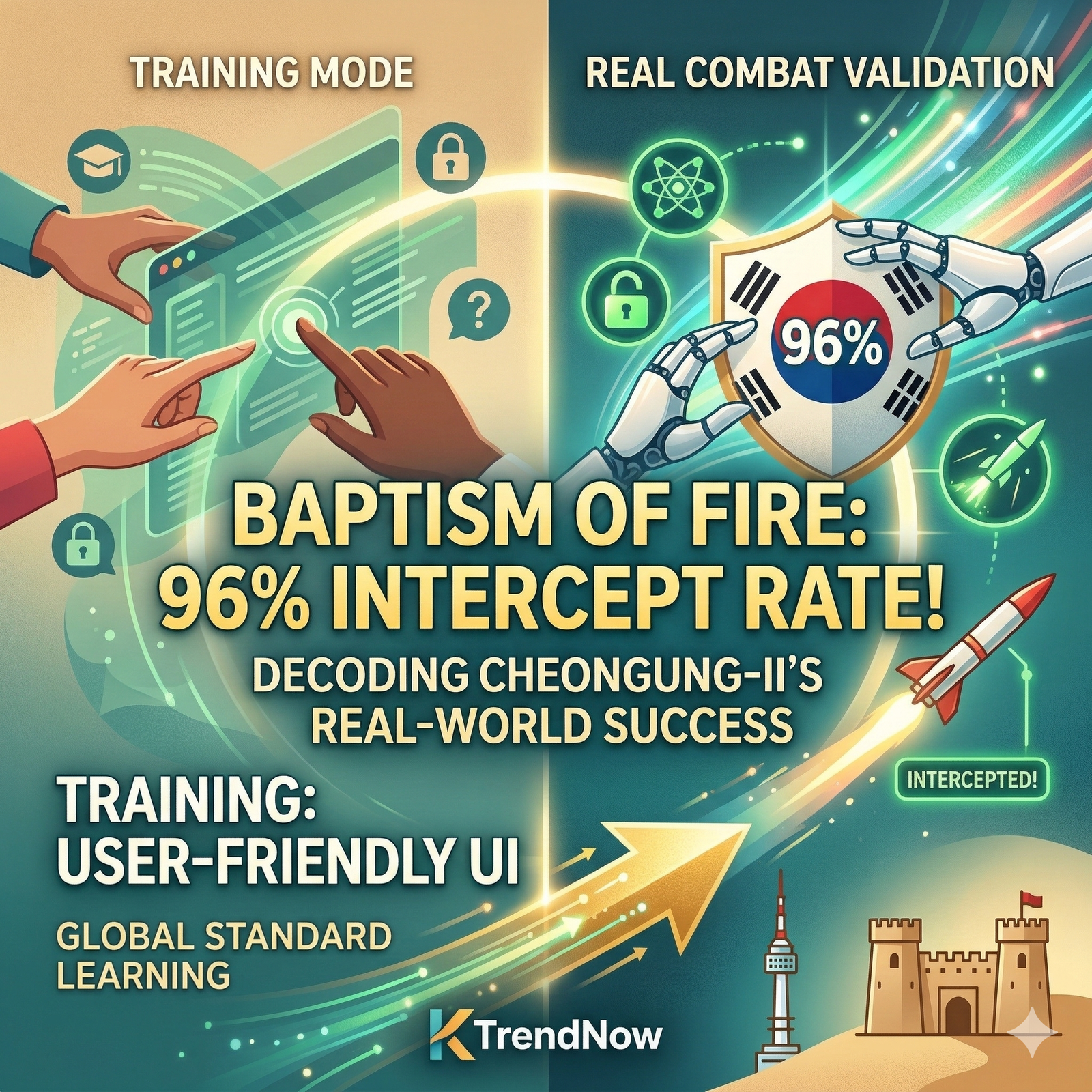
In the defense industry, there is a saying: “A thousand tests are not worth a single hour of combat.” In early 2026, the world witnessed this proverb come to life. The Cheongung-II (M-SAM) units, originally deployed to the UAE for research and training purposes, found themselves at the center of a real-world missile defense operation during an Iranian airstrike. The result? A staggering 96% intercept success rate, a figure that has sent shockwaves through the global military-industrial complex.
This wasn’t just a drill. It was the moment South Korea’s air defense technology transitioned from a promising contender to a battle-hardened legend.
Core Summary & The Golden Nugget
- Cheongung-II batteries, initially used for training, were instantly mobilized during an actual Iranian strike on the UAE, achieving a near-perfect 96% success rate in intercepting incoming threats.
- This “Baptism of Fire” proves that Korean systems are not only high-tech but also incredibly user-friendly and reliable, allowing training units to perform like elite front-line defenses.
- The 96% real-world success rate has fundamentally changed the global perception of K-Defense, moving it from a “cost-effective” option to a “top-tier performance” leader.
The One Thing to Remember
The 96% real-combat success rate in the UAE is the ultimate “Certificate of Trust” for K-Defense, proving that Korea’s tech is ready to defend sovereign skies at a moment’s notice.
Detailed Guide: The “96% Miracle” and the Shift in Global Security
For global defense analysts, the UAE event is being studied as a masterclass in modern electronic warfare and missile interception. The fact that a training-level configuration could handle high-speed ballistic threats with such precision highlights the robustness of the Cheongung-II’s radar and command systems.
Combat Performance: Cheongung-II (M-SAM) vs. Global Rivals
| Metric | Cheongung-II (M-SAM) | Patriot (PAC-3) | Strategic Takeaway |
| Real Combat Success | ~96% (UAE-Iran Incident) | ~80-90% (Historical Avg) | Korea’s latest AI tracking offers a slight edge in precision. |
| Operational Readiness | Training unit to Combat-ready (Instant) | Requires specialized combat crews | Superior UI/UX for fast deployment. |
| Desert Resilience | Validated in 50°C+ sandstorms | Long-term validation | Proven “Desert-Proof” reliability. |
| Intercept Method | Hit-to-Kill (Precision) | Hit-to-Kill (Precision) | Both are top-tier; Cheongung has lower cost-per-shot. |
| Market Reputation | The New “Guardian of the Gulf” | The Global Standard | Korea is now the “Go-to” partner for Middle East security. |
3 Strategic Impacts of the 96% Success Rate
- The Death of the “Second-Tier” Label: Before this incident, some critics labeled K-Defense as “Budget Defense.” The 96% success rate in a real conflict has silenced these critics. Global buyers now view Korea as a primary innovator in the high-end interceptor market.
- The “K-AS” (After-Sales) Boom: The UAE’s success was supported by the seamless integration and technical support provided by Korean engineers on the ground. This “Total Care” package is now a major selling point for other nations like Saudi Arabia and Romania.
- Data-Driven Sales Expansion: While other nations keep their combat data classified, the transparent success of the UAE’s Cheongung-II batteries acts as a public ledger of reliability. It has drastically reduced the “consideration phase” for new international buyers.
Action Plan: Navigating the K-Defense “Combat-Proven” Era
Step 1: Track the “Consumables” Market
Interception costs money. Watch for new contracts regarding the replenishment of the Cheongung-II interceptor missiles. Companies like LIG Nex1 are the primary beneficiaries of these high-volume resupply deals.
Step 2: Monitor “Deep Integration” News
Look for reports on how the UAE is now integrating Korean radar data into their broader command and control (C2) systems. This indicates a long-term, multi-decade dependency on Korean tech.
Step 3: Analyze “Regional Chain Reactions”
Neighboring countries often buy what their neighbors successfully use. Keep an eye on the defense procurement news from the GCC (Gulf Cooperation Council) countries; the 96% success rate is the best advertisement Korea could have asked for.
FAQ: The Truth Behind the 96% Success Rate
Q1: Was the 96% rate officially confirmed?
Yes, reports from the field and defense ministry insiders in the UAE have consistently pointed to this high success rate during the actual interception of Iranian missiles. It is considered one of the most successful combat debuts of a missile system in recent history.
Q2: Why did a training unit perform so well?
Korean defense philosophy focuses on “Automation and Accessibility.” The system is designed so that even with minimal combat experience, the AI-driven fire control system can make the most optimal decisions in milliseconds.
Q3: Is Cheongung-II now the best in the world?
While “best” is subjective, it is arguably the most modern and cost-efficient system available for export today. Its recent combat success makes it the most “verified” middle-range system for 2026.
Global Engagement Question
“A training unit saved the city.” It sounds like a movie plot, but it happened in the UAE. Do you think the future of warfare is heading toward a place where AI-driven systems make human ‘experience’ less critical? What would you prioritize if you were a general: a battle-hardened legacy system or a high-tech newcomer with a 96% success record? Let us know in the comments!