
Executive Summary
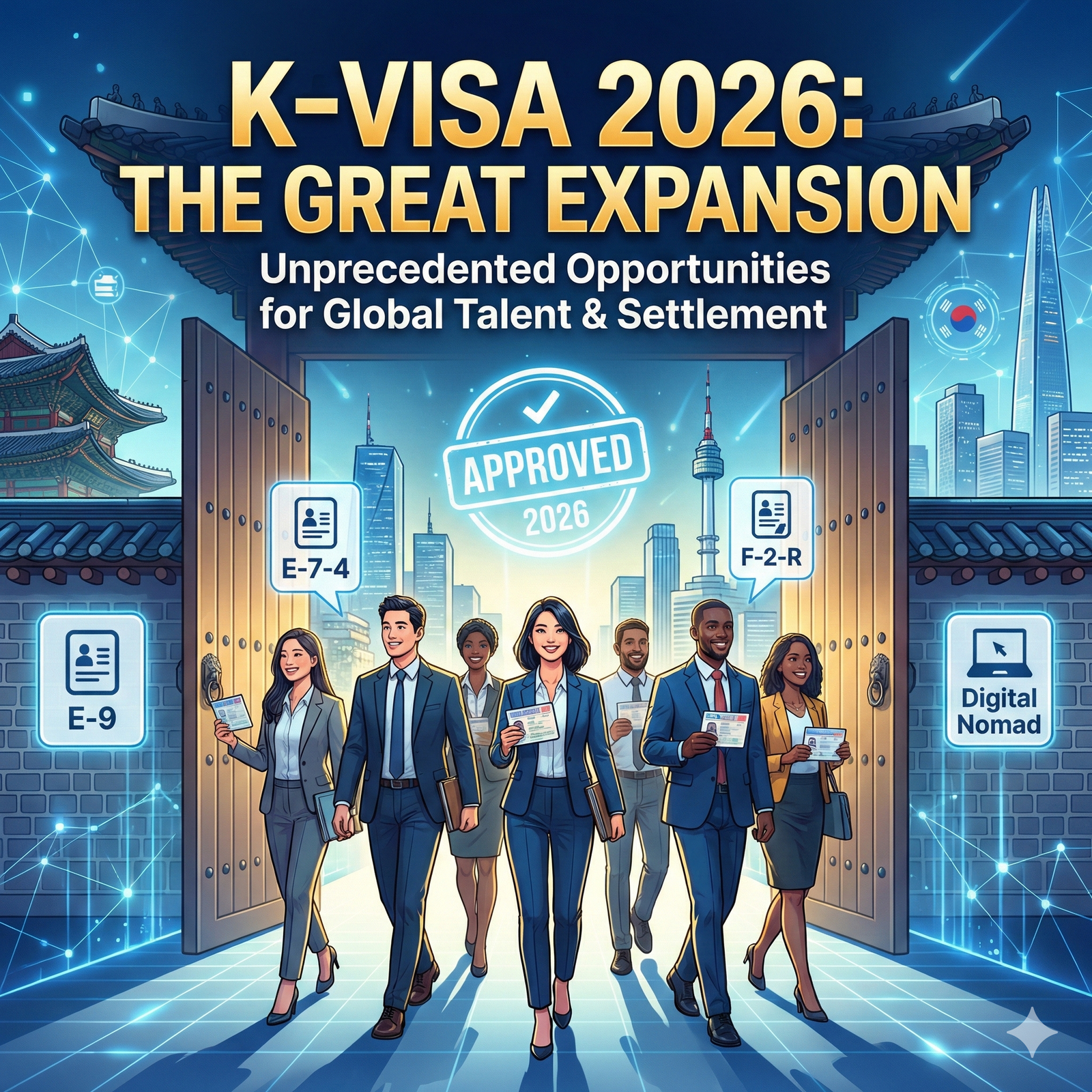
- Policy Direction: To address depopulation and labor shortages, the South Korean government has expanded foreign visa quotas to record levels for 2026, shifting the focus from simple labor importation to ‘Settlement’-oriented immigration policies.
- Key Changes: The permitted sectors for the E-9 (Non-professional) visa have expanded to include the entire hospitality and restaurant industries, while the Skilled Worker (E-7-4) quota has drastically increased to over 35,000, widening the path for long-term stay.
- Incentives: Through the relaxation of requirements for the Regional Specialized Visa (F-2-R) and the Digital Nomad Visa, Korea offers bold incentives such as permanent residency fast-tracks and family accompaniment for those settling in regions outside the Seoul metropolitan area.
Detailed Guide: Key 2026 K-Visa Changes and Quotas by Type
Starting in 2026, Korea’s visa system has evolved from ‘selective introduction’ to ‘active recruitment.’ The following table summarizes the key categories that global readers should note.
1. Policy Analysis by Major Visa Category in 2026
| Visa Code | Name | Major 2026 Updates & Expansion | Key Benefits |
| E-9 | Non-professional | Sectors expanded to hotels, condos, and general restaurants. | Largest quota in history (160,000+). |
| E-7-4 | Skilled Worker | Quota expanded to 35,000 (70% increase vs. past). | Allows for family invitation upon transition from E-9. |
| F-2-R | Regional Visa | Issued for residing in designated depopulated areas (89 districts). | Eligibility for F-5 (Permanent Residency) after 5 years. |
| K-Culture | Digital Nomad | Realistic income criteria and official remote work allowed in Korea. | Stay up to 2 years; optimized for global workations. |
| F-1-D | Domestic Helper | Source countries diversified from SE Asia to Central Asia. | Provides caregiving/housekeeping for dual-income households. |
2. Structure of the Settlement Fast-Track
Korea has designed a stepped advancement structure to ensure foreign talent can integrate as permanent members of society.
- Entry Stage (E-9, D-2/D-10): Enter Korea through the Employment Permit System (EPS) or a student visa.
- Skilled Stage (E-7-4): Transition to a professional visa based on Korean proficiency (TOPIK) and work experience.
- Settlement Stage (F-2-R / F-5): Acquire residency or permanent status by living in regional areas or meeting high-skill/income criteria.
Action Tips: Step-by-Step Plan for Successful K-Visa Acquisition
- Proactively Secure Korean Proficiency (TOPIK): Points for Korean language skills have been increased in the 2026 scoring system. Aim for TOPIK Level 3 or higher at least 6 months before applying.
- Early Completion of KIIP: The Korea Immigration & Integration Program (KIIP) is mandatory for permanent residency or residency visa transitions. Complete the levels immediately after entry to secure bonus points.
- Explore Regional Specialized Areas: It is much easier to obtain a visa if you receive a recommendation from local governments in depopulated areas (e.g., Gangwon, Je남, Gyeongbuk) rather than Seoul, often with additional perks like housing subsidies.
- Consult Registered Administrative Attorneys: As quotas increase, document screening has become more rigorous. Use a Ministry of Justice-registered agency to ensure no documents are missing.
FAQ
- Q1: Can I really bring my family on an E-9 visa?
- A1: The E-9 visa itself does not allow family accompaniment. However, if you successfully transition to E-7-4 (Skilled Worker) after working in Korea for a certain period, you gain the right to invite your spouse and children.
- Q2: Isn’t the income requirement for the Digital Nomad Visa too high?
- A2: In the 2026 revision, a ‘Tech Talent Track’ was created to lower the barrier for those with specific skills (IT, Design, etc.), allowing for entry even if the income is slightly below the general high-income threshold.
- Q3: Is my visa canceled if I move away from a Regional Specialized (F-2-R) area?
- A3: Yes. Since this visa is conditional on residing in a specific region, moving to another area (especially the Seoul metropolitan area) without permission can lead to cancellation. Moving within the same designated region is permitted.
Sources
- Ministry of Justice (MOJ) Korea Immigration Service 2026 Work Plan
- Ministry of Employment and Labor (MOEL) Foreign Workforce Quota Announcement
- Ministry of Culture, Sports and Tourism (MCST) Global Workation & K-Culture Visa Activation Plan