
Executive Summary
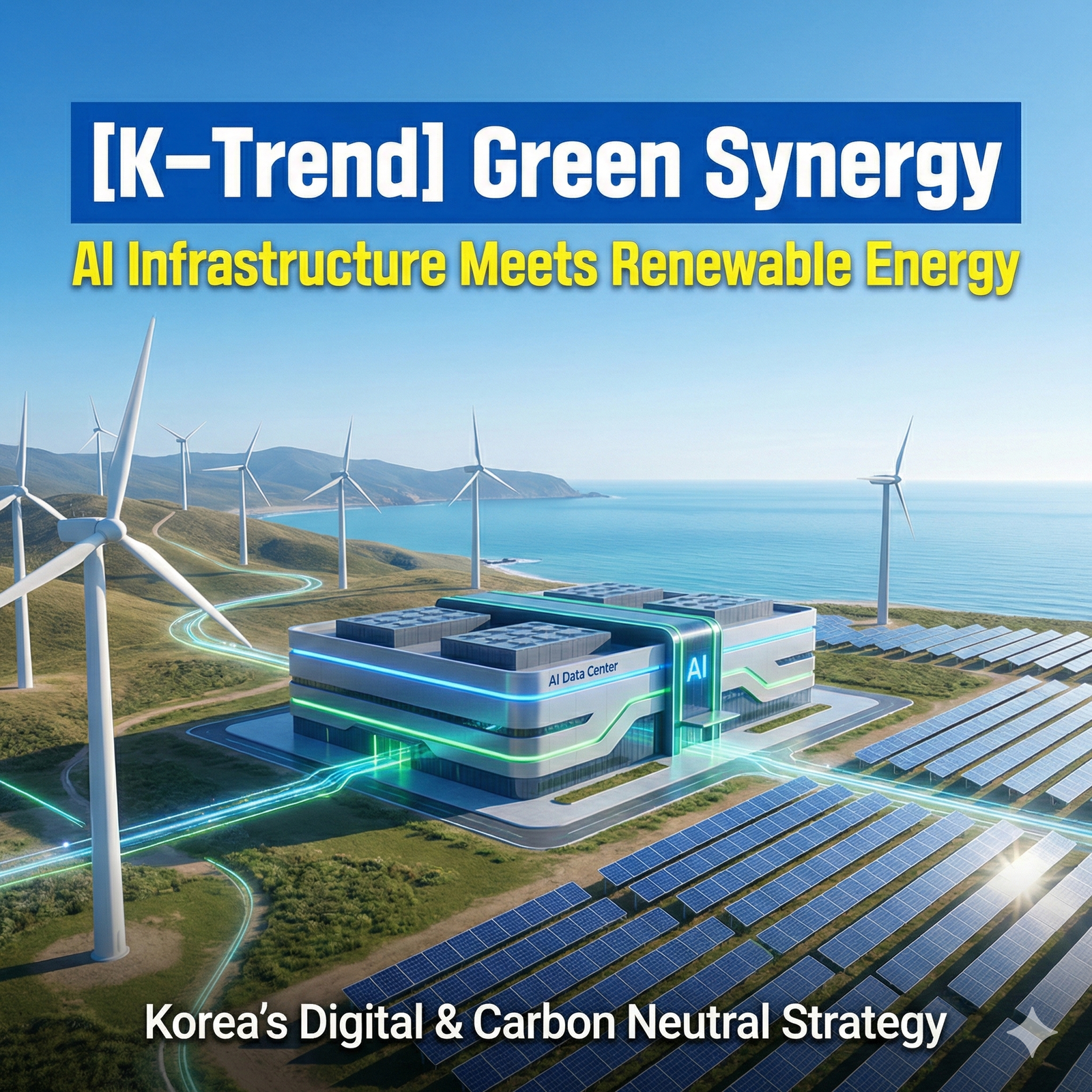
- Strategic Definition: It refers to a ‘digital-energy convergence’ model that covers the massive power required to run AI with renewable energy and, conversely, uses AI technology to maximize the efficiency of energy grids.
- Core Infrastructure: By utilizing ‘Distributed Energy Special Zones’ and the ‘Honam AI Computing Grid’ starting in 2026, a low-carbon, high-efficiency ecosystem is built where data is processed directly at the power production sites.
- Economic Expected Effect: Through the injection of 13.8 trillion KRW in government budget and private investment, South Korea aims to respond to global RE100 requirements and strengthen the export competitiveness of its AI semiconductors and energy infrastructure.
Detailed Guide: Analysis of the Green Synergy Economic Model
K-Green Synergy is not just environmental protection but a national action plan to overcome the era of high energy costs and secure the sustainability of the AI industry.
1. Traditional Digital Economy vs. Green Synergy Model
| Category | Traditional Digital Economy Model | Green Synergy Model | Key Changes |
| Primary Energy | Centralized power based on fossil fuels | Renewables like Solar, Wind, and Hydrogen | Clean energy transition without carbon |
| Grid Structure | Long-distance transmission (Centralized) | Distributed grid (Local production/consumption) | Minimizing loss and securing stability |
| Data Center Location | Concentrated in metropolitan/urban areas | Near energy production (Saemangeum, Honam) | Resolving regional imbalance |
| Role of AI | Info processing and service provision | Optimization of demand prediction and control | AI as a core tool for energy management |
| Global Standard | Purchase of carbon credits by individuals | Compliance with RE100 & Climate Neutral DC | Strengthening export competitiveness |
Three Core Strategies for Green Synergy
- Establishing Green AI Data Centers
- Liquid Cooling & Ultra-high Density Design: Data centers built from 2026 onwards will adopt water-cooling systems as a standard to lower the Power Usage Effectiveness (PUE).
- Activation of PPA (Direct Power Purchase): Systems allowing data center operators to buy power directly from renewable energy plants will be prioritized in distributed zones.
- AI Grids Based on Distributed Energy Special Zones
- Honam AI Computing Grid: Infrastructure with over 52,000 high-performance GPUs will be built in the Honam region, rich in solar and wind power, forming an ‘Energy Highway’.
- Differential Regional Tariffs: Electricity price incentives will be provided to regions where production and consumption are adjacent, encouraging corporate relocation to provinces.
- Hydrogen-AI Convergence Ecosystem (Saemangeum Hub)
- 10 Trillion KRW Saemangeum Project: Led by the private sector, including Hyundai Motor Group, a mega cluster combining hydrogen production, robotics, and AI data centers will be created.
- Clean Hydrogen Fuel Cell Power: To ensure continuous power stability for AI centers, ‘uninterrupted green energy’ systems using hydrogen fuel cells as base-load power will be demonstrated.
Action Tips: Action Plan for Businesses and Investors
- Review Locations in Special Zones: If planning a new data center or power-intensive business, prioritize the Honam or Saemangeum zones where PPAs and tax benefits are concentrated.
- Adopt AI Energy Management Systems (EMS): Move beyond just using renewables; utilize AI to predict power demand for factories or buildings in real-time to manage peak loads and reduce costs.
- Prepare ESG Disclosures: In preparation for the ‘Energy Efficiency Rating System for Digital Services,’ digitize your IT infrastructure’s carbon emissions and proactively obtain eco-friendly certifications.
- Collaborate on Green Hydrogen Infrastructure: If steady energy supply is required, participate in projects to build hybrid energy systems based on electrolysis and hydrogen fuel cells in cooperation with local governments.
FAQ
- Q1: Is renewable energy stable enough for AI center operations?
- A1: ‘Hybrid Grid’ technologies combining Energy Storage Systems (ESS) and hydrogen fuel cells are applied to solve this. Furthermore, AI analyzes weather data and demand in real-time to optimize supply, securing over 99.9% stability.
- Q2: Will Green Synergy policies lead to electricity price hikes?
- A2: The government is restructuring industrial tariffs to lower prices during daytime (excess renewable supply) and introducing regional differential pricing. This offers cost-reduction opportunities for companies near production sites.
- Q3: Can foreign investors or global companies participate in this ecosystem?
- A3: Yes. Global investment groups like BlackRock have already committed trillions of won to Korean renewable energy-AI projects, and the government is actively encouraging foreign investment by creating an environment that meets global RE100 standards.
Sources
- Ministry of Trade, Industry and Energy (MOTIE) 2026 Budget and Key Work Plan
- Ministry of Climate, Energy and Environment Implementation Strategy for Distributed Energy Zones
- Korea Advanced Institute of Science and Technology (KAST) Report on Honam Ultra-Wide Area Revitalization