
Executive Summary
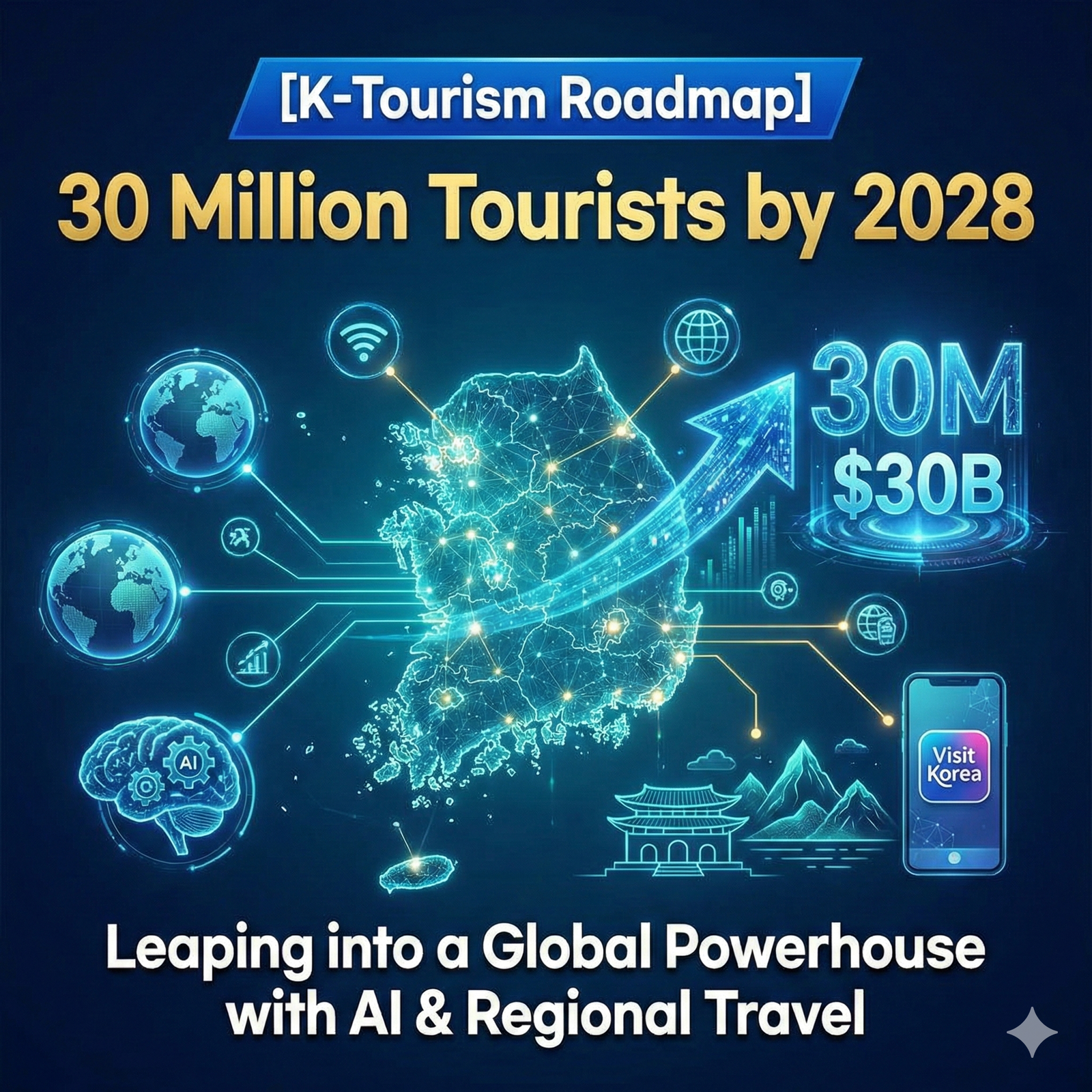
- Goal Acceleration: The South Korean government and the Korea Tourism Organization (KTO) have officially declared their aim to bring forward the goal of attracting 30 million foreign tourists to 2028, two years earlier than the original 2030 target.
- Three Core Pillars: Beyond just increasing numbers, the roadmap focuses on expanding visitor volume, extending length of stay, and a full-scale transition to AI-based services, fostering tourism as a national strategic industry comparable to semiconductors and automobiles.
- 2026: Year of Execution: Designating 2026 as the “First Year of Execution,” the government will consolidate 13 fragmented tourism information sources into the “Visit Korea” hub and fully deploy AI travel assistants and integrated transportation passes for foreigners.
Detailed Guide: Key Strategies and Action Plans for the K-Tourism 3.0 Roadmap
The “Tourism Great Transformation” roadmap pushed by the Korean government includes a multi-dimensional strategy combining technology, culture, and regional growth. The following table summarizes the action plans by sector.
| Category | Key Strategy | Details and Benefits for Global Users |
| AI Digital Innovation | Data-driven Personalized Services | AI Travel Assistant: Hyper-scale AI-based multilingual chatbot assisting from itinerary design to bookings. Visit Korea Integration: Consolidating 13 fragmented websites into one app for one-stop information. Smart Data Lab: Analyzing visitor movements with AI to provide personalized tourist attraction recommendations. |
| Regional Tourism | Solving Seoul Concentration (Hub-and-Spoke) | Creating 2nd & 3rd Tourism Zones: Discovering regional attractions through large-scale developments in Gyeongsang and Jeolla provinces. Digital Tourism Resident Card: Providing significant discounts on accommodation and dining when visiting population-declining areas. Regional Love Vacations: Expanding stay-oriented contents in rural and island areas with expense reimbursement support. |
| Inbound Convenience | Removing Entry and Mobility Barriers | Extension of K-ETA Exemptions: Simplifying entry procedures to lower psychological barriers for foreign tourists. Integrated Tourism & Transport Pass: Launching combined products of unlimited public transport and admission to paid tourist attractions for foreigners. Digital Payment Expansion: Increasing domestic acceptance of overseas payment methods and expanding instant-refund duty-free shops. |
| High Value-added Market | Fostering Premium Themed Tourism | Medical & Wellness Convergence: Strengthening high-profit packages combining K-beauty, health check-ups, and spas. Global Festival Linkage: Developing products linked with K-pop concerts, international sports events, and large-scale MICE events. Stay-oriented Content: Activating ‘K-Workation’ or long-term digital nomad visas beyond simple short visits. |
Action Tips: Step-by-Step Action Plan for Foreign Readers Traveling to Korea in 2026
- Install the Visit Korea App: Design your own customized Korean travel route using the integrated AI travel assistant service.
- Apply for a Digital Tourism Resident Card: Apply for this digital card beforehand to receive local-level discounts when traveling to regional provinces outside Seoul.
- Review the K-Workation Visa: If you want to combine work and leisure, check the eligibility for the Korean-style digital nomad visa and book a co-living house.
- Purchase the Integrated Transport Pass: Receive your foreigner-exclusive transport pass immediately upon arrival at the airport to move across the country without complex payment processes.
FAQ (Frequently Asked Questions)
- Q1: How long is the K-ETA exemption valid?
- A1: Currently, the government is continuously pushing to expand targets and extend the duration of temporary K-ETA exemptions in conjunction with the 2026-2027 Visit Korea Year. Always check the official Visit Korea website for the latest list of eligible countries before your trip.
- Q2: What languages does the AI Travel Assistant support?
- A2: It starts with English, Chinese, and Japanese, with plans to sequentially expand to major languages of Southeast Asia and the Middle East to provide multilingual integrated chatbot services.
- Q3: Is transportation inconvenient when traveling to regional cities?
- A3: The government is improving infrastructure by linking ‘Tourist Shuttles’ and ‘Integrated Transport Passes’ centered around regional hub airports and train stations so that foreigners can easily access local attractions without a rental car.
Sources
- Ministry of Culture, Sports and Tourism (MCST) 2026 Key Work Plan Report
- Korea Tourism Organization (KTO) Press Conference Material for New President
- 10th National Tourism Strategy Meeting: ‘Three Major Strategies for Tourism Innovation’