
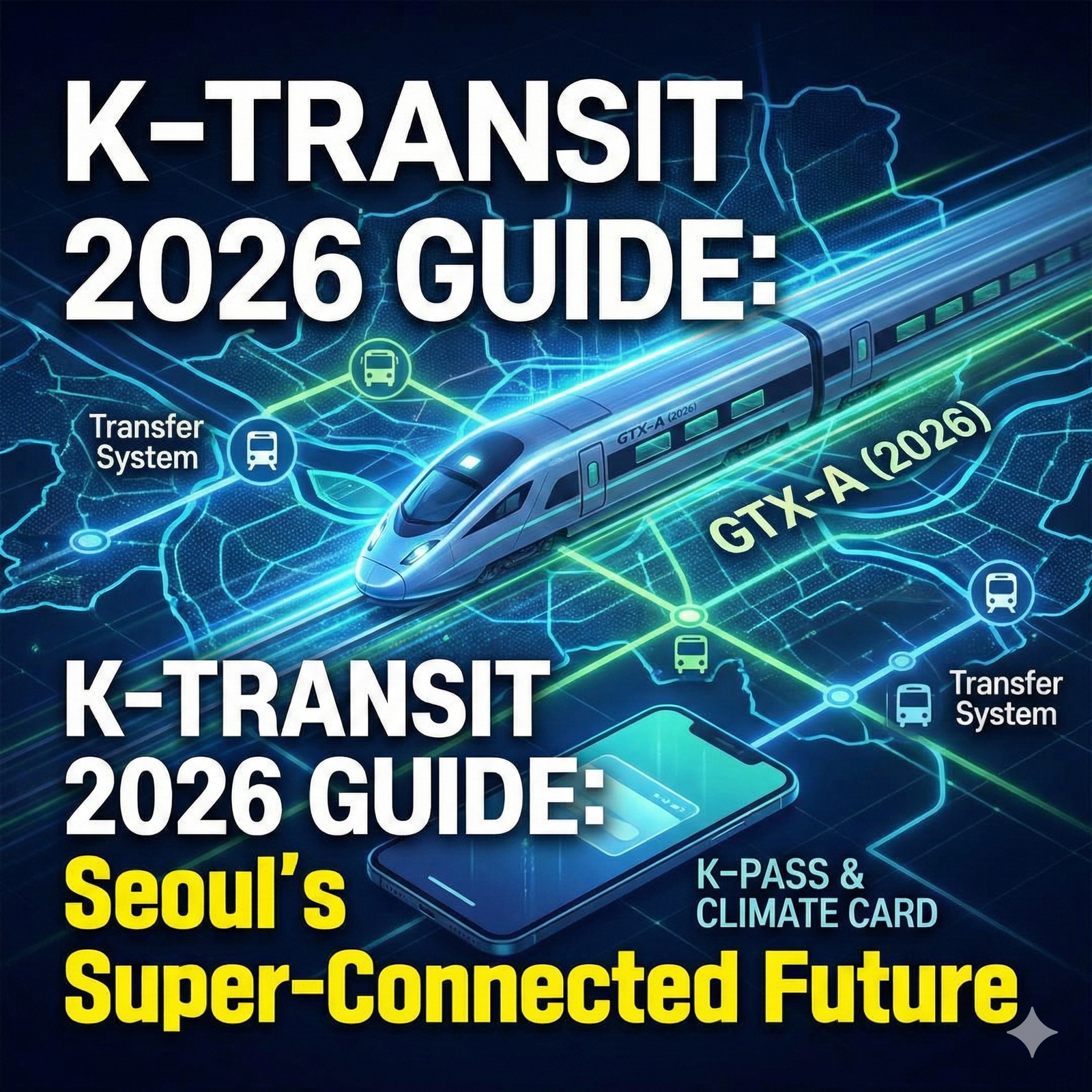
Executive Summary
- South Korea’s public transportation features a world-class integrated transfer system where subways, buses, and Great Train eXpress (GTX) are connected through a single payment platform.
- As of 2026, the full opening of the GTX-A line has reduced commuting times to 30 minutes within the metropolitan area, alongside radical fare refund benefits via K-Pass and the Climate Card.
- International tourists and residents can significantly cut travel costs by using smartphone NFC features or specialized passes to access real-time information and unlimited transit tickets.
Detailed Guide: 2026 Korean Public Transit System and Key Benefits
Korean public transit is unparalleled in its punctuality and connectivity. In 2026, the service has evolved beyond traditional modes to integrate high-speed regional rail with advanced digital passes.
1. Transport Characteristics and 2026 Updates
| Mode | Key Features | Major 2026 Updates |
| Subway | Dense network of 24 lines, guaranteed punctuality | AI-driven congestion alerts and upgraded screen doors in all stations |
| GTX-A | Deep-underground (40m) express rail, top speed 180km/h | Full operation from Unjeong (Paju) to Dongtan via Seoul Station and Samseong |
| Bus | Connects subway blind spots, dedicated bus lanes | Expansion of autonomous late-night routes and full adoption of hydrogen buses |
| Transfer | Base fare waived when switching modes within 30 mins | Full integration of GTX-A into the discount transfer system |
2. Comparison of Transit Passes for Users
Choosing the right pass based on your travel pattern is essential for economic efficiency.
| Pass Name | Scope | Benefits | Remarks |
| Climate Card | Seoul subways, buses, and Ttaereungyi | Unlimited rides for 60,000–70,000 KRW/month | Short-term passes (1, 3, 5, 7 days) available for tourists |
| K-Pass | Nationwide public transit | 20% to 53% post-usage refund for 15+ trips/month | Refund based on frequency regardless of distance |
| K-Transit AI | Entire Metropolitan Area | AI-recommended optimal routes and automatic discount application | Mobile-based real-time integrated payment service |
Action Tips: Step-by-Step Plan for 200% Efficiency
- Purchase and Register Cards: Buy a ‘T-money’ or ‘Cashbee’ card at airport convenience stores or subway stations. Since 2026, most mobile payments (Samsung Pay, Apple Pay, etc.) are directly compatible with transit readers.
- Install Essential Apps: Download ‘Naver Map’ or ‘KakaoMap.’ These apps provide real-time train locations, bus seat availability, and optimal transfer paths in multiple languages.
- Follow Transfer Rules: Always tag your card when exiting. Transfer discounts are applied automatically if you switch within 30 minutes (60 minutes between 9 PM and 7 AM).
- GTX-A Precautions: As stations are located deep underground, allow 5–10 minutes extra to reach the platform. Transfer discounts remain valid even through dedicated GTX gates.
- Utilize Amenities: Make use of free public Wi-Fi at all stations and wait in designated ‘Cooling Fog’ zones in summer or on ‘Heated Benches’ in winter.
FAQ
- Q1: Can I pay with cash on buses or subways?
- A1: While subways have single-use ticket machines that accept cash, Seoul buses are now strictly “cash-free.” You must have a card, which can be purchased at any nearby convenience store.
- Q2: Which pass is best for international tourists?
- A2: If you are staying within Seoul, the “Climate Card Tourist Pass” is highly recommended. It offers unlimited rides for a few days at a price point of 5,000 to 20,000 KRW.
- Q3: What should I do if I miss the last train?
- A3: You can take an ‘Owl Bus’ (N-Bus), which runs from 11:30 PM to 6:00 AM, or use a ride-hailing app (Kakao T, Uber). Autonomous late-night shuttles also connect major hubs as of 2026.
Sources
- Ministry of Land, Infrastructure and Transport (MOLIT) 2026 Metropolitan Transit Plan
- Seoul Metropolitan Government ‘Climate Card’ Operating Manual
- Integrated Guide from KORAIL and Seoul Metro