
Executive Summary
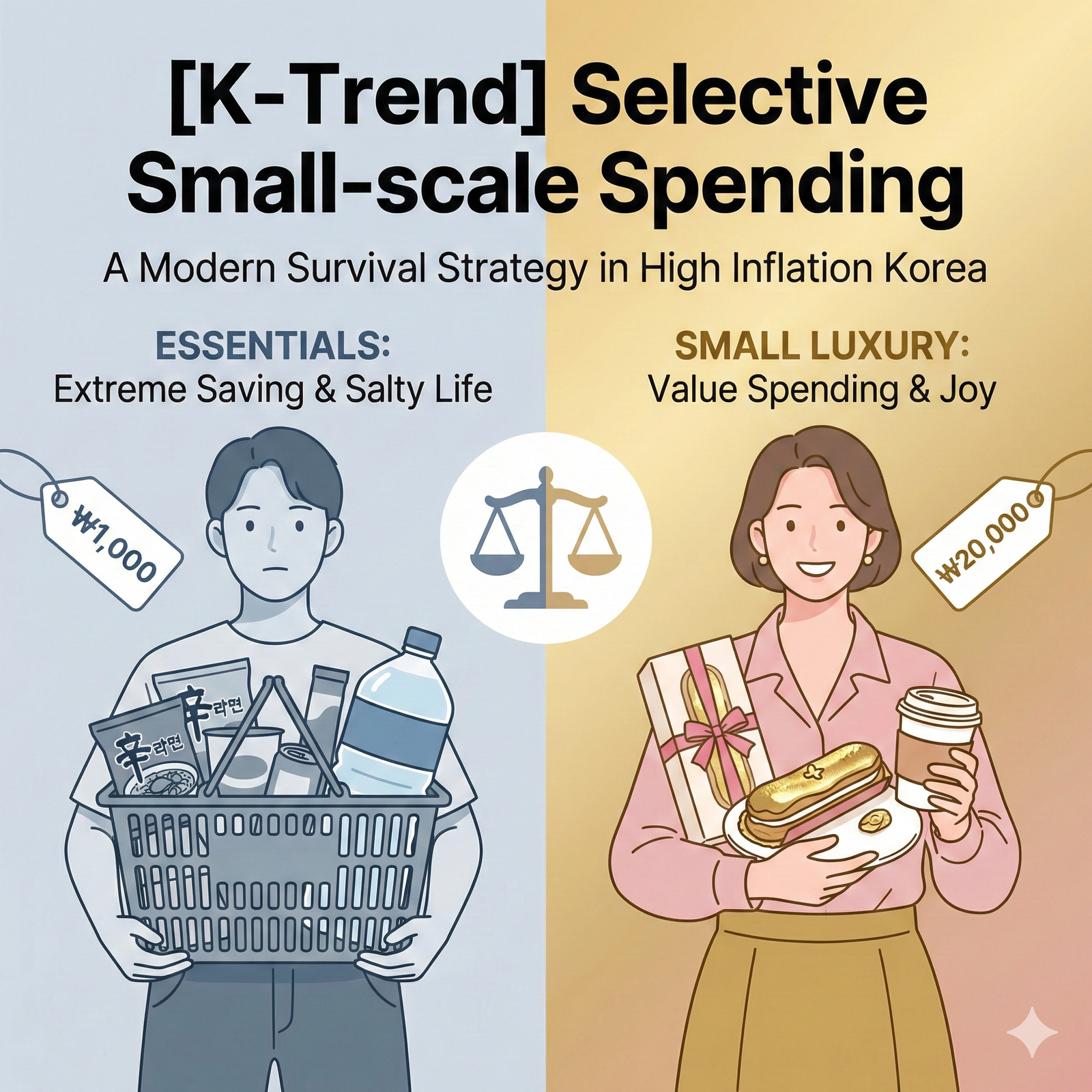
- Definition: It refers to a polarized consumption pattern where individuals practice extreme frugality (Salty Life) on essentials like groceries while spending boldly (Small Luxury) on specific tastes or hobbies they value.
- Background: This is a pragmatic choice by the Korean MZ generation to maintain psychological satisfaction by strictly reorganizing consumption priorities instead of practicing absolute abstinence amid prolonged high interest rates and inflation.
- Market Impact: It accelerates the ‘fragmentation of consumption,’ where the use of C-commerce (Ali, Temu, etc.) for low-cost bulk purchases and the growth of high-priced, taste-based limited edition markets occur simultaneously.
Detailed Guide: Analysis of Selective Small-scale Spending by Segment
Selective small-scale spending in Korean society is more than just saving money; it is a highly strategic form of consumption designed to maintain one’s identity through the efficient allocation of resources.
| Category | Extreme Saving Area | Selective Value Spending Area | Remarks & Key Trends |
| Items | Processed foods, essentials, telecom, transport | Coffee/desserts, limited goods, performances, self-dev | Clear separation of ‘survival’ and ‘pleasure’ |
| Primary Channels | Daiso, C-commerce, PB brands, discount apps | Pop-up stores, select shops, resell platforms (KREAM) | Polarization of distribution channels |
| Core Value | Lowest price search, Price-performance (Ga-seong-bi) | Psychological satisfaction (Ga-sim-bi) | Priority on ‘quality of experience’ over price |
| Behavior | Collecting 10-won points, No-spend challenges | Small Luxury, Meaning-out (Value signaling) | Re-investing saved money into personal tastes |
| Social Spread | ‘Beggar rooms’ (saving communities) | Niche, taste-based elite communities | Digital-based collective consumption culture |
Socio-Economic Mechanisms Supporting Selective Small-scale Spending in Korea
- Popularization of Ultra-low-cost Platforms and Consumer Protection
- To reduce costs in the essential goods sector, the use of platforms like AliExpress and Temu has surged. In response, the Korean government is strengthening safety nets through the ‘Comprehensive Measures for Overseas Direct Purchases,’ which includes verifying hazardous ingredients and enhancing consumer damage relief systems.
- Psychological Compensation via Small Luxury
- As achieving large-scale goals like purchasing a home or marriage becomes difficult, young people seek immediate accomplishment by buying premium lipsticks or high-end desserts (e.g., Dubai chocolate) instead of luxury bags. This serves as a tool for maintaining ‘resilience’ among Korean youth.
- Integration with Resell-tech
- There is a strong perception that ‘consumption is investment,’ as limited edition shoes or art toys purchased in the value spending area can be resold at higher prices later.
Action Tips: 5-Step Action Plan for Efficient ‘Selective Small-scale Spending’
- Dichotomous Classification of Expenses: Clearly list ‘items to strictly save on’ and ‘items to invest in for myself’ from your monthly fixed expenses.
- Utilize Closing Discount & Group Buy Apps: Reduce grocery costs by more than 30% through restaurant closing discount apps like ‘Last Order’ or group purchase platforms like ‘Always.’
- Open a ‘Taste Account’ for Value Spending: Transfer the difference saved in the frugality area to a separate account to spend without guilt when engaging in high-cost hobby activities or purchasing desired items.
- Subscribe to Pop-up Store & Free Exhibition Info: Pre-emptively secure information on free pop-up stores in areas like Seongsu-dong and Hannam-dong via ‘Catch Table’ to experience brand sensibilities without spending much.
- Combine Digital Points and Government Vouchers: Maximize available funds by actively linking practical government welfare benefits, such as cultural expense income deductions or K-Pass (transportation reimbursement), to the saving area.
FAQ (Frequently Asked Questions)
- Q1: Is selective small-scale spending just a fleeting trend?
- A1: It has moved beyond a trend to become a structural consumption pattern in Korean society, where low-growth trends are entrenched. The ‘Ambiviewer’ tendency, enjoying both frugality and luxury simultaneously, is expected to intensify.
- Q2: Does this way of consuming encourage overspending?
- A2: The key is ‘selection’ and ‘concentration.’ It is not about spending in all areas; because of extreme saving in unnecessary areas, the overall spending volume tends to remain at a manageable level.
- Q3: Can foreign residents participate in this trend?
- A3: Certainly. Daiso and ultra-low-cost online platforms are open to foreigners, and consuming Korea’s unique pop-up store culture or regional limited edition goods is the best way for global readers to experience the latest Korean lifestyle.
Sources
- Statistics Korea (KOSTAT) Consumer Price Trends and Spending Pattern Analysis
- 2026 Trend Korea and Korea Broadcast Advertising Corporation (KOBACO) Consumer Behavior Survey
- Ministry of Economy and Finance Press Release on Overseas Direct Purchase Consumer Protection Policies