
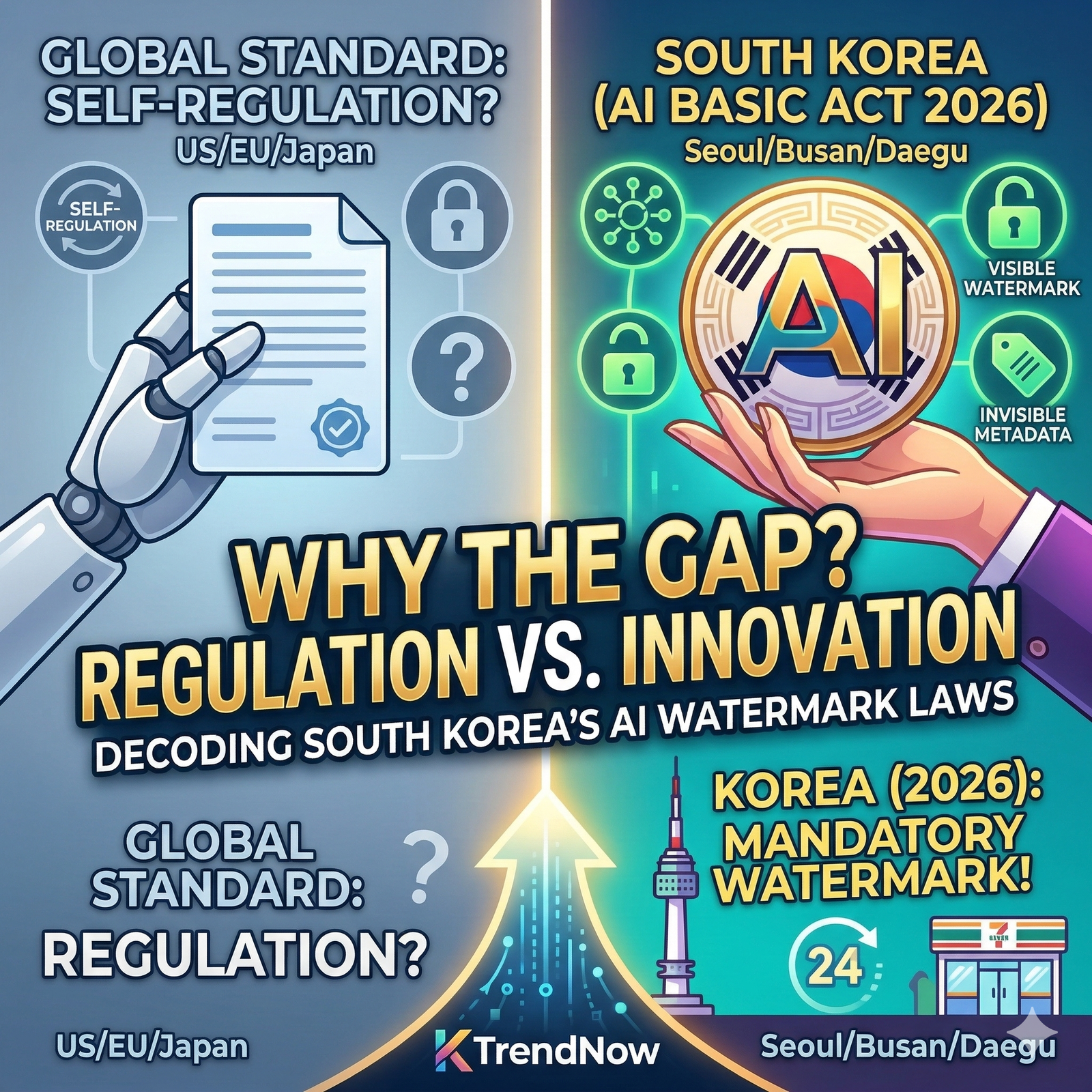
South Korea has officially entered a new era of digital accountability. As of 2026, the implementation of the AI Basic Act has made it mandatory for all AI-generated content—including images, videos, and audio—to carry a clear watermark indicating its artificial origin. This is not merely a technical suggestion; it is a legal requirement enforced by the Ministry of Science and ICT (MSIT).
For global creators, tech firms, and digital marketers targeting the Korean market, understanding these nuances is critical. Korea is currently leading the global charge in legislative efforts to combat deepfakes and ensure transparency in the AI age. This post provides an in-depth look at what this means for you and how it compares to other international regulations.
Core Summary & The Golden Nugget
- Under the 2026 AI Basic Act, South Korea mandates the inclusion of visible and invisible watermarks on all generative AI outputs to protect the public from misinformation and deepfakes.
- The regulation applies to both domestic and international entities operating or providing services within South Korea, with non-compliance potentially leading to administrative orders and fines.
- This proactive stance positions Korea as a primary testing ground for global AI governance, bridging the gap between technological innovation and social trust.
The One Thing to Remember
In the Korean digital ecosystem, transparency is the new currency; failing to disclose AI-generated content is no longer a minor oversight but a legal liability.
Detailed Guide: Decoding Korea’s AI Watermark Mandate
South Korea’s digital landscape is one of the most connected in the world. This high level of connectivity has made the nation particularly vulnerable to the rapid spread of deepfakes and AI-generated disinformation. Consequently, the government has shifted from voluntary labeling to a strict, law-based mandate.
Comparing Global AI Disclosure Regulations
| Feature | South Korea (AI Basic Act 2026) | EU (AI Act) | USA (Executive Order) |
| Watermark Mandate | Mandatory for all generative AI | High-risk/General-purpose AI | Voluntary for most private sector |
| Oversight Body | Ministry of Science & ICT (MSIT) | European AI Office | NIST & Sector-specific agencies |
| Enforcement Mechanism | Corrective orders & Fines | Heavy fines based on turnover | Contractual & Administrative focus |
| Technical Standard | Visible + Metadata (Required) | Informing users (General) | Standards under development |
Technical Specifications for Compliance in Korea
The MSIT has laid out specific technical expectations to ensure that a watermark serves its purpose without being easily circumvented.
- High Contrast and Legibility: Visible watermarks must be placed in a way that they are easily noticed by the average user. Text like “Generated by AI” or a standardized icon must remain legible even if the image is resized.
- Robust Metadata Tagging: Invisible watermarks must be embedded within the content’s metadata. This ensures that even if the visible portion is cropped out, software tools and platforms can still identify the file’s AI origins. Techniques like C2PA (Coalition for Content Provenance and Authenticity) are being adopted as the industry standard here.
- Resistance to Manipulation: The regulation encourages the use of advanced techniques like frequency-domain watermarking or AI-based latent watermarking, which are difficult to remove using standard image editing software. The government is actively funding R&D to provide creators with tools that make watermarks more “tamper-proof.”
Action Plan: A Step-by-Step Guide for Global Entities in Korea
If you are a creator or a business operating in the Korean digital space, here is your roadmap to staying compliant.
Step 1: Audit Your AI Tech Stack. Ensure that the generative models you use—whether they are proprietary or third-party like OpenAI or Midjourney—support the insertion of watermarks. Most global providers have updated their APIs to meet Korean standards as of early 2026.
Step 2: Implement Multi-Layered Labeling. Do not rely solely on a corner logo. Integrate metadata tagging into your export workflow. If you are a platform host, ensure your system can read and display these tags to the end-user.
Step 3: Monitor MSIT Guidelines. The Ministry frequently updates its “Best Practices” document. Assign a compliance officer to review these updates quarterly to ensure your technical implementation remains current with evolving standards.
FAQ: Navigating the 2026 AI Landscape
Q1: Does this law apply to AI-enhanced content, such as simple photo retouching?
Generally, no. The law targets content where the “core substance” is generated by AI. Minor edits or retouching using AI-powered tools like Adobe Photoshop’s generative fill may fall into a gray area, but full-scale generations must be labeled.
Q2: What are the actual penalties for ignoring this?
Non-compliance can result in a staged enforcement process: first, a corrective order to fix the issue, followed by public disclosure of the violation, and ultimately, substantial fines if the behavior continues.
Q3: Is Korea’s law a barrier to innovation?
While some argue it adds friction, the Korean government views it as a “trust-builder.” By ensuring users know what is real and what is AI, they believe they are creating a safer market for legitimate AI businesses to flourish without being tarnished by deepfake scandals.
Global Engagement Question
Do you believe that every single AI-generated image should have a mandatory watermark, or should it depend on how the image is used? As we move into an era where AI is indistinguishable from reality, how do you define the right to know the truth versus the right to creative freedom? Let’s discuss in the comments below!