
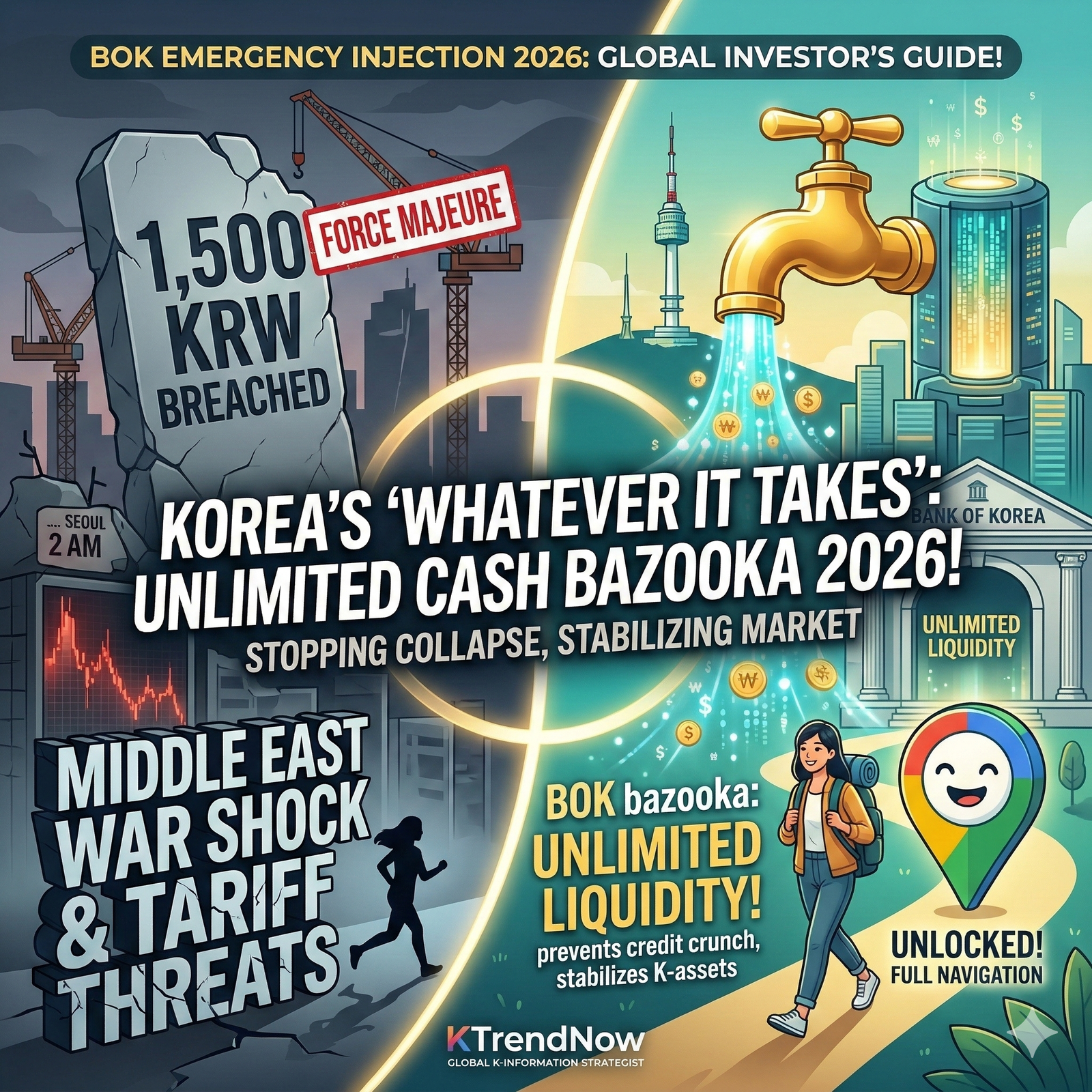
The global financial community woke up to a seismic announcement from Seoul today. As the Korean Won (KRW) breached the psychological 1,500 mark and the stock market faced intense selling pressure, the Bank of Korea (BOK) deployed its most powerful monetary weapon: an unlimited liquidity injection through Repo (RP) purchases. This move is a direct response to a perfect storm of 25% tariff threats from the U.S. and the sudden suspension of 100 trillion KRW worth of Middle Eastern infrastructure projects due to escalating conflict. For global investors, this represents a “Whatever it takes” moment that could define the bottom of the current K-market cycle.
Core Summary & The Golden Nugget
- In a pre-dawn emergency session, the Bank of Korea announced it would purchase an unlimited amount of Repurchase Agreements (RPs) to provide a massive liquidity buffer to the financial system.
- This historic intervention aims to neutralize the fear-driven exodus of capital caused by the 1,500 KRW exchange rate spike and the “Force Majeure” declarations on critical Middle Eastern infrastructure projects.
- For international spectators and asset holders, this signal effectively halts the domino effect of potential bankruptcies in the construction and financial sectors, providing a much-needed foundation for market stabilization.
The One Thing to Remember
The BOK’s unlimited liquidity pledge is a strategic fortress designed to prevent localized shocks from turning into a systemic collapse, offering a rare window of institutional protection for value seekers in Korean assets.
Detailed Guide: The BOK’s “Nuclear Option” vs. Global Standards
To understand why this is a massive deal, global investors must look past the jargon. An “Unlimited RP Purchase” means the central bank is telling commercial banks and brokerages, “Give us your bonds as collateral, and we will give you as much cash as you need to stay afloat.” This is not a common maneuver; it is a crisis-management tool used only when the gears of the financial system threaten to seize up.
Strategic Comparison: BOK 2026 vs. Global Central Bank Interventions
| Feature | BOK Unlimited RP Purchase (2026) | US Fed Quantitative Easing (QE) | Global Implications |
| Core Mechanism | Providing cash in exchange for collateral (Short-term) | Buying assets permanently to expand the balance sheet | BOK focuses on immediate liquidity, not permanent expansion |
| Scalability | Unlimited and Uncapped based on demand | Usually fixed at a monthly purchase rate | BOK’s move is more flexible and reactive to real-time panic |
| Primary Goal | Preventing credit crunches and stabilizing KRW | Lowering long-term yields and boosting inflation | BOK is playing defense against external geopolitical shocks |
| Asset Coverage | High-quality corporate and government bonds | Government debt and Mortgage-Backed Securities | Protects the bedrock of the domestic financial industry |
Why This Matters for the Global Community in 2026
- Stabilizing the “Force Majeure” Fallout: With 100 trillion KRW in Middle Eastern projects halted, Korean construction giants faced an immediate cash flow crisis. The BOK’s liquidity bazooka ensures that these companies can settle their short-term debts without triggering a chain reaction of defaults that would impact their global partners.
- Counteracting the Trump Tariff Shock: The leaked 25% tariff plan on Korean cars and chips sent shockwaves through the market. By stabilizing the financial system, the BOK allows these tech titans to focus on supply chain restructuring and “Human-in-the-Loop” AI innovations rather than worrying about a localized banking crisis.
- The “Digital Disaster Alert” Integration: In tandem with the BOK’s financial shield, the newly activated Google Maps real-time disaster alerts in Korea are helping residents navigate the physical risks of the current geopolitical climate. This combination of financial and technological resilience is reinforcing Korea’s status as a high-tech sanctuary even during global turmoil.
Action Plan: Navigating the K-Market Volatility
Step 1: Strategize your KRW currency entry. With the BOK actively intervening, the era of unpredictable 20-30 won daily swings is likely over. Spread your currency conversions over the next 10 days to capture the average stabilized rate.
Step 2: Focus on “Resilient Tech” sectors. Look for companies specializing in Human-in-the-Loop AI and semiconductor firms that are maintaining export value despite the 4.4% production drop. These are the first firms that will bounce back once the liquidity flows into the equity markets.
Step 3: Diversify into BOK-backed bonds. As the central bank supports the bond market, high-quality Korean corporate bonds currently offering high yields due to panic may see a significant price recovery in the coming months.
FAQ: What Global Investors are Googling
Q1: Does “Unlimited Liquidity” mean the Korean Won will lose all its value?
Actually, the opposite is often true during a panic. By providing liquidity, the BOK restores confidence. When the market knows the central bank is the “Lender of Last Resort,” the desperate selling of KRW assets often stops, which can lead to a stabilization or even an appreciation of the won.
Q2: How long will this unlimited purchase stay in effect?
Typically, these measures are reviewed weekly. The BOK has indicated that it will keep the tap open until the “Force Majeure” impacts in the Middle East are fully assessed and market volatility settles.
Q3: Is my investment in Korean startups safe under this new act?
Startups often struggle when venture capital dries up during a credit crunch. By ensuring that major banks have plenty of cash, the BOK is indirectly keeping the venture capital pipelines from freezing over, which is great news for the K-Startup ecosystem.
Global Engagement Question
How does your country’s central bank compare when it comes to “emergency bazookas”? Do you think the BOK’s aggressive “Unlimited” approach is a smarter move than the Fed’s gradual QE? We want to hear your perspective on central bank strategies during global wars!